


Ferrari 156
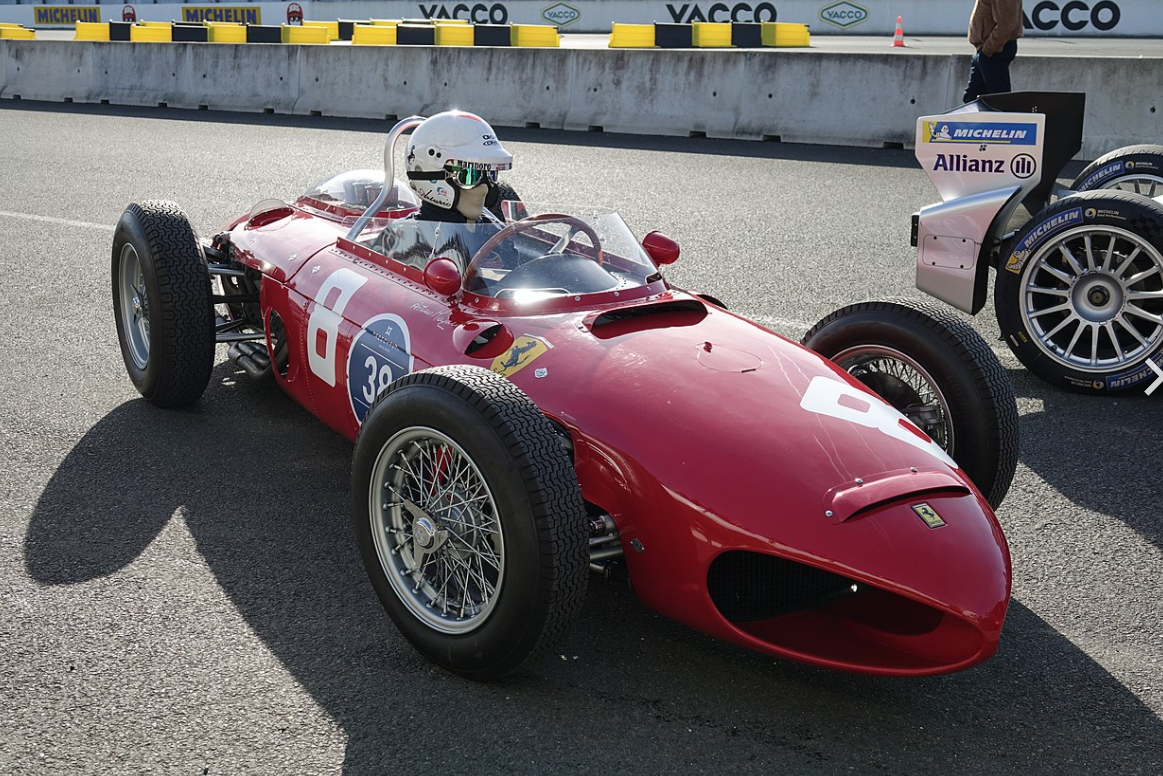
Car: Ferrari 156 / Engine: 120 degree V6 / Maker: Ferrari / Bore X Stroke: 73 mm X 58.8 mm / Year: 1961 / Capacity: 1,486 cc / 90.8 cu in / Class: Formula 1 / Power: 190 bhp at 9,500 rpm / Wheelbase: 2300 mm / Track: Front: 1260 mm Rear: 1260 mm / Weight: 460 kilo / 1,014 lbs

Ferrari joined the rear-engine revolution with the Ferrari 156 “Sharknose”. This Ferrari race car was designed by a new engineer Carlo Chiti. The chassis was a tubular spaceframe that while not in the same league with designs created by Lotus and BRM it proved serviceable. The star of this car was the 120 degrees V6 engine that was a developed for the new regulations. The angle of the cylinder blocks allowed for the engine to have a lower center of gravity. Because the engine was substantially wider its rear placement was deemed necessary. Another striking feature of the new engine was its relative light weight, weighing 30 lbs. lighter than the four-cylinder Coventry-Climax engine still being used by the British teams.

While the British teams argued about the necessity of the new formula Ferrari had a brand new car and engine to start the season. The cars first season bore fruit with five victories out of seven races including a 1-2-3-4 finish at Spa. Only tremendous victories at Monaco and the Nurburgring by Stirling Moss could stop the red cars. The World Championship was a battle between Phil Hill and von Tripp and was won by American Phil Hill. His three victories providing the winning margin.

Unfortunately the successful season was marred by the tragic death of Hill’s teammate, Wolfgang von Tripp and 14 spectators at Monza. The lack of a competitive engine for the British teams changed in 1962 and Ferrari failed to win a race. Ferrari was also racked by internal politics which resulted in the departure of eight top Ferrari executives including Carlo Chiti. The Ferrari 156 continued to be used for two more years with John Surtees and Lorenzo Bandini scoring single wins in 1963 and 1964 respectively.